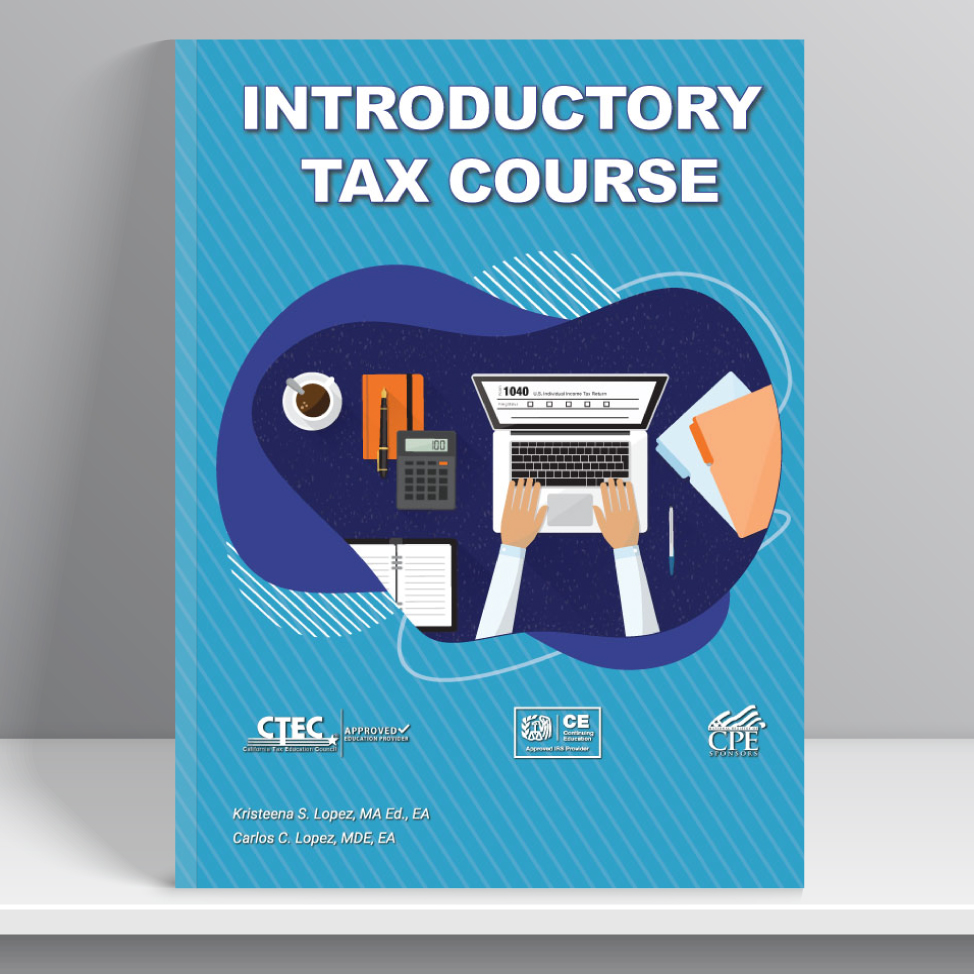
Introductory Tax Course eBook

CE Credits: 8 Federal Tax Law · 2 Behavioral Ethics · 10 Hours

A 10-hour introductory course for people who already understand the basics of how taxes work and want to apply that knowledge as a paid preparer. Covers income, credits, deductions, and professional ethics. Fully self-study, at your own pace.

In this course you will learn:

  • How to interview a taxpayer and determine the correct filing status
  • How to identify the credits a taxpayer qualifies for
  • How a nonrefundable credit affects a taxpayer’s tax liability
  • How to uphold the professional and ethical standards the job demands

$206.08

- +

Description

CE Credits
8 Federal Tax Law  ·  2 Behavioral Ethics  ·  10 Hours total

New to professional tax preparation? This course is your entry point. You already understand the basics of how taxes work, and now you’ll learn how to apply that knowledge as a paid preparer: how to interview a taxpayer, determine the correct filing status, identify the credits they qualify for, and uphold the professional and ethical standards the job demands.

In 10 hours, you’ll build on what you already know, covering income, adjustments, other taxes and penalties, payments and credits, itemized deductions, and the ethical responsibilities that come with preparing someone else’s return. No classroom and no long wait. Enroll today and start building your professional foundation right away.

What you’ll be able to do

  • Explain how a nonrefundable credit affects a taxpayer’s tax liability
  • Recognize professional responsibility in tax preparation
  • Know a tax preparer’s responsibilities to the taxpayer

How this course works

All materials are included. You study independently through readings and lessons, then sit for a final exam at your own pace.

Course chapters

  1. Filing status, dependents, and deductions. Learn how to determine the right filing status, who qualifies as a dependent, and how to choose between the standard and itemized deductions.
  2. Income. Understand the types of taxable income, from wages and tips to interest and dividends, and where each belongs on the return.
  3. Adjustments to income. Discover above-the-line deductions like student loan interest and IRA contributions that reduce taxable income.
  4. Other taxes and taxpayer penalties. Learn about additional taxes such as self-employment tax, and the penalties taxpayers may face for underpayment or late filing.
  5. Payments and tax credits. See how withholding, estimated payments, and credits like the Child Tax Credit and EIC reduce what a taxpayer owes.
  6. Itemized deductions. Work through Schedule A deductions including mortgage interest, medical expenses, and charitable contributions.
  7. Ethics. Review the professional standards and responsibilities tax preparers must follow, including Circular 230 guidelines.

Final exam. The final exam tests your knowledge across all chapters to earn your CE credits.

Course details

Field of study Federal Tax Law (8 hrs), Behavioral Ethics (2 hrs)
Course level Basic
Prerequisite General tax preparation knowledge is required
Delivery method Self-study
CE credit deadline May 31, 2027
Upon completion Certificate of Completion
IRS credit reporting CE credits reported directly to the IRS for tax preparers with a valid PTIN

This course does not qualify for California Continuing Education hours.
Chapters

Chapters

Chapter 1: Ethics

This chapter will explain how to determine who qualifies as a tax return preparer, what representation rights a preparer has, how that individual is bound by the Circular 230 guidelines, and what it means for a tax preparer to behave ethically and responsibly.

Chapter 2: Best Practices to Counteract Cybercrime

Protecting yourself and your clients is one of the biggest challenges that tax return preparers face today. Criminals have learned that tax return preparers have a lot of information about their customers, including their Social Security numbers, information about their families, and employment history. Criminals want to steal this information and weaponize it to steal money from banks, the IRS, or conduct other crimes.

Chapter 3: Compiling Taxpayers Information

This chapter explains the importance of interviewing the taxpayer. Each segment of the chapter will cover a section of Form 1040 with sample interview questions that are needed for the section discussed. The tax professional needs to understand the importance of knowledgeable questions to determine if the taxpayer is eligible to claim certain credits. Interview questions asked should be documented as well as the answers the taxpayer provided. Knowing basic tax law is essential.

Preparing tax returns is an art; knowing which questions to ask will help determine the best tax situation for the individual. Just imputing information into software does not prepare an accurate tax return. The saying is true: “garbage in, garbage out”. Entering incorrect information so that the taxpayer receives a higher refund is not the best situation for you or the client. This chapter provides you with a brief overview of current year forms and sample questions to determine the best tax position for the taxpayer. Asking the taxpayer, the right questions from the beginning provides the tax preparer accurate answers needed to complete the tax return.

Chapter 4: Filing Status, Dependents and Deductions

This chapter will present an overview of the Tax Cuts and Jobs Act standard deduction and what circumstances permit taxpayers to claim a higher standard deduction. You will also learn what an exemption is, what exemptions each of the filing statuses can claim, and how to identify a qualifying dependent.

Chapter 5: Income

The IRS has the authority to tax all income from whatever source it is derived. This includes compensation for services, gains from dispositions of property, interest and dividends, rent and royalties, pensions and annuities, gambling winnings, and even illegal activities. All such income a person receives is collectively referred to as “worldwide income.” However, not all money or property is taxable or subject to tax. This chapter will cover the different types of taxable and nontaxable income and show you where and how to report such wages on a professionally prepared tax return. A tax professional must recognize the different kinds of taxable income, tax-exempt income, and other income included in Schedule 1, line 21, and must know how to figure out the taxable percentage on Social Security benefits.

Chapter 6: Tax Credits and Payments

A nonrefundable tax credit reduces the amount of tax liability that may have to be paid. Unlike a deduction, which reduces the amount of income that is subject to taxation, a credit directly reduces the tax itself. There are two types of credits: nonrefundable, which cannot reduce tax liability below zero, and refundable, which can reduce tax liability below zero, resulting in the need for a refund.

Chapter 7: Adjustments to Income

In this chapter, students will learn how various expenses are used to “adjust” or lower the taxpayer’s income to arrive at his or her adjusted gross income (AGI). They will also learn how the Tax Cuts and Jobs Act (TCJA) has impacted adjustments at the federal level and how to handle any previous-year returns that preceded those TCJA-mandated changes.

Chapter 8: Itemized Deductions

When computing taxable income, personal expenses cannot be claimed as itemized deductions; however, tax rules do allow for some deductions that are essential for daily living. These specific expenses are deductible as itemized deductions. A standard deduction is a set amount that the taxpayer can claim based on his or her filing status. Itemized deductions are shown on the tax return using Schedule A, Itemized Deductions. The taxpayer must decide whether to itemize deductions or use the standard deduction and should choose whichever option is best for their tax situation.

Chapter 9: Other Taxes and Taxpayer Penalties

This chapter provides an overview of miscellaneous taxes from the Form 1040 and reported on Schedule 2 that a taxpayer might be assessed. This includes excess Social Security tax, additional taxes on IRAs, the Alternative Minimum Tax, and household employment taxes.

Course Details

Course Details

Course Details Included in this course
Title: 2023 Introductory Tax Course
Level: Beginner
Delivery Method: Self-study
Scroll to Top